
Boss design is a common design in a plastic part, it is used for mating part or for attaching fasteners such as screws or accepting threaded inserts. if our engineers design a bad boss in a plastic part, we will meet many molding problems, so I think The wall thicknesses of a boss should be less than 60 % of nominal wall. of course, it depends on the boss’ position in a plastic part, if it is in an unimportant or invisible position, the wall thickness can be increased a little. even can be used self-tapping screw, a greater radius at the base would be better, a least 0.25 x thickness. Gussets or connecting ribs reinforce the boss.
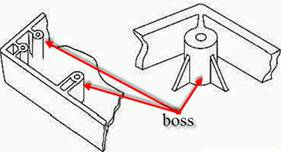
Bosses are common structures on plastic parts in home appliances and interior and exterior of automobiles, mainly for positioning and fastening.
The base of bosses often cause sink marks on the back surface of a part, this is because of the large wall thickness. The solution is to core out some material at the base,
There are two additional points to consider in designing bosses. As mentioned earlier, a boss is a circular rib, and like any rib, its walls—both inside and out—must be drafted to facilitate ejection. Depending on the height of the boss, this draft can be anywhere from a half degree to 3 degrees. If draft of the inside diameter of the boss is not acceptable, the boss can be molded as a solid and the inside diameter drilled, by you, as a secondary operation. Also, because a boss is formed by a blind hole in the mold body, we may have to add vent pins to the rim of the boss to allow the escape of trapped gas during mold filling. Otherwise shorts or burns may form on the rim.
Many part designers have studied mechanical engineering and used mainly metals in their design work. The necessary differentiation by designing a metal or plastic part is therefore a lot of times unknown. However, it is truly mandatory, as the correct design of the plastic part saves material, cycle time and therefore money. A plastic part design makes the cooling of the mold easier, because less hot spots will appear. Furthermore, the first trial will be more successful, because less defects will be visible at the part, which need to be corrected.
The design and placement of bosses is critical in injection moulding. As with all injection moulding, shrinkage is a major consideration. Shrinkage looks bad, and more importantly if shrinkage affects your bosses then they might not align properly causing delays in assembly.
The important things to look out for are:
– The thickness of the boss should be 60% or less of the parts nominal wall thickness.
– Bosses need to be tied in place with ribs and fillets, to prevent warping.
– The Internal diameter of screw bosses should be slightly less than the screw thread and their length should provide at least 60% of the screw thread with something to catch on.
Bosses serve two purposes. Their primary use is to strengthen holes or slots in the surface of your part. Plastics designers love thin walls, but thin and strong are opposites ends of the trade-off spectrum. Bosses are the happy medium, reinforcing fracture prone features like screw holes, penetrations or mounting slots without impacting the cost or looks of a design.
The secondary use of bosses is to create points at which your assembled product can be fastened together. Injection moulding is all about speed, and not just in the actual moulding. Properly designed plastic parts bring down costs by being designed for rapid assembly. Take apart a high quality plastic product, and it should be easy to put it back together again. The bosses should line up and show you how parts fit, and then those bosses should hold the parts in place, ready for a fastener or clip to permanently fix them in place.
I think the experience about this design detail is very helpful, I got it